


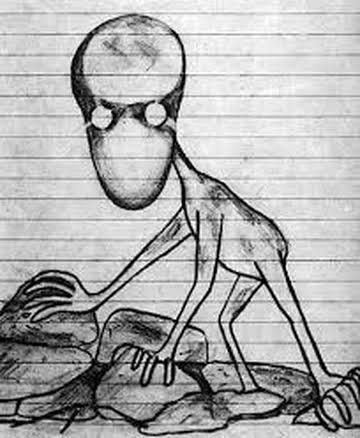
On a dark road in Dover, Massachusetts, in April 1977, a teenage boy’s headlights swept across an old stone wall. For a few seconds, he saw something crouched there. It was small, pale and thin, with long fingers wrapped around the rocks and a head far too large for its body. Then it turned. Two glowing eyes stared back from the edge of the light. By the time he looked again, it was gone. At first, it sounded like one strange sighting. But within 26 hours, two more teenagers would report seeing something almost identical on the roads of Dover. Then the creature vanished completely.
No body. No proof. And no explanation.
This is the unsettling story of the Dover Demon.
Most monster stories are built slowly. They begin as rumours, then grow through retellings. Newspaper mentions, local gossip and second-hand accounts pass from one person to another until the original event becomes difficult to separate from the legend. A strange sound in the woods becomes a creature. A shadow on the roadside becomes a warning. A frightened witness becomes the first piece of a story that eventually takes on a life of its own. But the Dover Demon did not grow that way. It did not come from some ancient New England legend. It was not tied to a burial ground, an old curse, a haunted house or a forgotten colonial crime. There were no centuries of folklore surrounding it before people started talking. No local superstition warned children to stay away from certain roads because something might get them. Before April 1977, the Dover Demon did not exist in the public imagination at all. Then, for a little more than a day, it was there. In the span of roughly 26 hours, three teenagers in Dover, Massachusetts, claimed to have seen something none of them could properly explain. Each sighting happened at night and near a quiet road, and each involved a small, strange creature with a thin body, limbs that seemed too long and a head that appeared far too large for its frame.
Dover sits southwest of Boston. Although it is not far from the city, Dover has always had a quieter, more rural character than people might expect from a town so close to a major urban area. In the 1970s, Dover had stretches of road lined with trees, stone walls and large properties. There were also dark bends through the trees where headlights were often the only thing separating a driver from the night around them. It was not a wilderness, but there were places that could feel very empty and liminal after sunset. Those details matter because the Dover Demon was not seen in some distant forest or remote mountain range. It was seen in a familiar town, on roads people use every day. And that makes this story more uncomfortable. A monster in a faraway swamp can keep its distance, but a strange creature on a road near someone’s house is a little different. It makes ordinary places feel less secure. It suggests that the impossible does not have to live deep in the wilderness. Sometimes, according to stories like this, it only has to wait at the edge of the headlights.
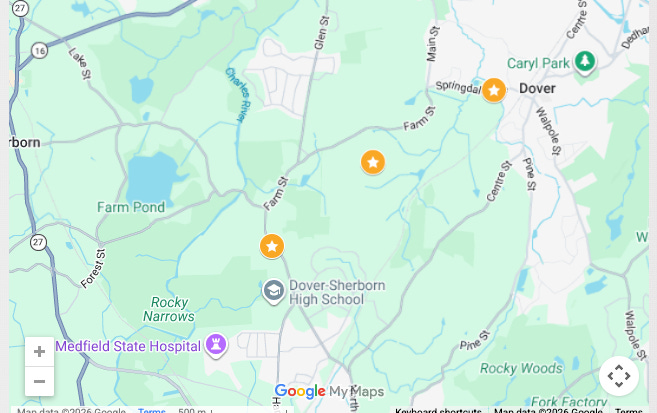
The first sighting happened on the night of 21 April 1977. Seventeen-year-old Bill Bartlett was driving along Farm Street in Dover with two friends in his car. It was around 10:30 that night, and the evening itself seemed ordinary. There was nothing about the road, that car ride or that moment that should have become famous. It was just a group of teenagers passing through town, moving through a familiar place under the cover of darkness. As Bill drove, the headlights of the car swept across the pavement and roadside. Those headlights would have briefly revealed pieces of the landscape before letting them fall back into darkness. Tree trunks, brush, mailboxes and old stone walls. Most of what the headlights caught would have been forgotten instantly. But at one point, near a stone wall along Farm Street, Bill saw something that stayed with him for the rest of his life. At first, his mind tried to interpret it as something normal. It is how people usually respond when they see something strange. They do not immediately leap to monsters. They search for a familiar category: an animal by the road, a dog, a cat or maybe even a raccoon. Maybe it was some injured creature crouched near the stones.
For a second, that may have been enough. But as the car got closer and the headlights revealed the thing more clearly, the ordinary explanations began to fail. The creature was small. It did not have the compact, recognisable shape of a raccoon or a dog. Its body looked thin and oddly proportioned. Its limbs seemed long and spindly. Its head appeared huge compared to the rest of its body, almost swollen, as if the body beneath it was too underdeveloped to support it properly. The thing appeared to be positioned on or near the stone wall. One of the most unsettling details Bill later gave was that it appeared to have long fingers wrapped around the rocks.
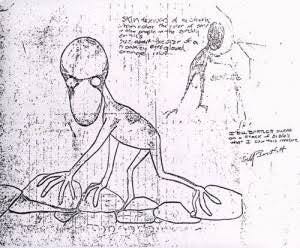
That image has become one of the defining images of the Dover Demon story. A pale, small-bodied creature crouched against a stone wall. Its long fingers gripping the stones as a car approached in the dark. The detail is disturbing because it gives the creature an almost human quality without actually making it human. A paw, a claw or a hoof would have pushed the sighting towards an animal explanation. Then Bill saw its face, or at least what passed for one. There did not appear to be a clear mouth. There was no obvious nose and no visible ears that he could recognise. The face seemed almost unfinished, dominated by two large eyes that reflected the headlights with an orange glow. The eyes were not necessarily glowing, but they seemed to reflect the light in the way an animal’s eyes can at night. But paired with the creature’s strange shape and blank face, that reflection made the sighting unforgettable. The skin was later described as pale or peach-coloured, with a rough texture that reminded him of sandpaper or sharkskin. The sighting lasted only seconds. Bill was driving, the car was moving and the creature was at the side of the road. But a few seconds can be enough when an image is disturbing enough. He saw something crouched against the wall, something with a huge head. A thin body, long fingers and the rest. Then the car passed, and the creature was behind him. Inside the car, the world suddenly split into four. Bill had seen something impossible. For Bill, something impossible had just appeared in the headlights. For his friends, nothing had happened because they had not seen it. They had missed the moment. Maybe they were looking somewhere else or talking, or simply not focusing on the roadside at the exact second the car passed.
That detail makes the first sighting feel even more isolating. It is one thing to see something frightening with other people and have them confirm it. It is another to turn to the people beside you and realise that you are alone with what you saw.
Then Bill had to wrestle with what he had seen. Did he really see what he saw? Was it some animal caught in a strange position, its shape distorted by the headlights? Had his mind filled in details that were not there? Those were all reasonable questions. But they do not erase the force of the experience. He was shaken enough that he turned the car around and went back. It is one of the most important parts of the first sighting because it shows that Bill did not simply laugh it off or let the moment pass. He wanted to see the thing again. He wanted some kind of confirmation that it was an animal. Maybe it was still there. Maybe it had been a trick of the light. Maybe returning to the same spot would make the explanation obvious. But when the car returned, the stone wall was empty, the creature was gone and the dark roadside looked normal again. Whatever Bill had seen had vanished into the surrounding darkness, leaving no simple explanation behind. When he got home, Bill drew it. That sketch has become one of the most famous pieces of evidence in the Dover Demon case, showing the creature in all its infamous glory.
The drawing looked less like a known animal and more like something between categories. It had the posture of something upright, the head of something almost alien and the hands of something disturbingly close to human. Bill reportedly insisted that he had seen the creature, and people who have written about the case often note that he did not appear to be treating the incident as a joke. If that had been the only sighting, the Dover Demon might never have become famous. One teenager seeing something strange at night is unsettling, but it is not enough to build a lasting mystery. It could have been an animal, a trick of the headlights or a moment of misperception. Most people would have missed it. Over time, the story might have survived only as a strange memory told amongst friends. But the night was not over.
A few hours later, another teenager in Dover saw something strange. His name was John Baxter. He was 15 years old. At around midnight, he was walking home from his girlfriend’s house near Miller Road. His encounter was, in some ways, more unnerving than Bill Bartlett’s. John was not protected by a moving car. He was not sealed behind glass, with an engine carrying him away. He was on foot, walking alone at night through a quiet area where the darkness around him would have felt much closer. At first, John noticed a figure in the distance ahead of him. It seemed as though it could have been another person. This is another believable detail because, again, his first reaction was not to assume that he was seeing a monster. He thought he might be seeing someone else walking nearby. Maybe it was another kid, perhaps someone from the neighbourhood. Then the shape began to seem odd, but it was still within the range of something his mind could explain. He called out to it. If it was a person, calling out should have produced some kind of response. A turn of the head, a word or a gesture. Some sign that the figure belonged to the ordinary world. But there was no answer.
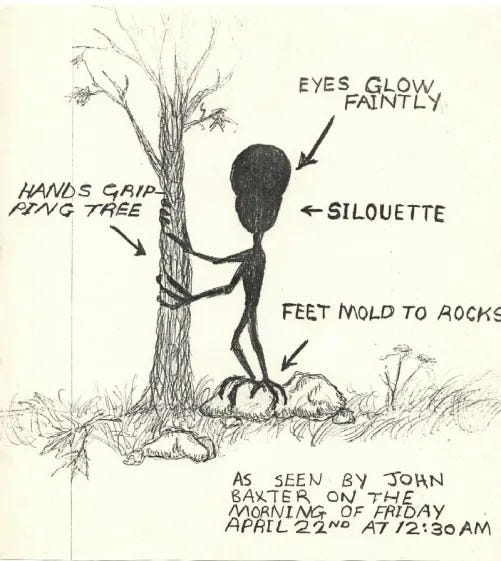
John continued walking and, as he got closer, the figure became harder to explain. Its proportions seemed wrong. Its head appeared too large for its body. Its limbs once again appeared thin and awkward. The shape did not move or stand quite the way a person should. The closer he got, the less human it seemed. Until the explanation he had started with no longer worked. That slow shift is what makes John Baxter’s sighting so frightening. Bill’s encounter was sudden, a shocking image caught in the headlights. John’s was gradual. He had time to approach, time to call out and time to realise that something ahead of him was not what he thought it was. There is a particular kind of fear in that kind of recognition. Then the figure reportedly moved and ran off towards a wooded area, into a gully or down a slope near the road. John followed it far enough to see it near a tree, where it appeared to brace itself against or cling to the trunk. Again, the detail of long fingers appears in this account. Bill had seen long fingers gripping stone. John saw something with long fingers near a tree. The repetition of that detail is one reason the case became so compelling to people who later studied it. There was no attack. The creature did not chase John or try to harm him. It seemed to flee or move away. The creature seemed almost evasive. John’s encounter added a second point to the story. Now there were two separate sightings on the same night, in the same town, both involving young witnesses and both describing a small figure with a large head, thin limbs and strange hands or fingers. The sightings were not identical, and they did not need to be. In fact, if they had been identical, they might have sounded rehearsed. Instead, they overlapped in the broad details while remaining different in the specific circumstances, which is often how genuine witness accounts tend to behave.
The next day, the story began to take shape. A strange creature had been seen in Dover. At least two teenagers were talking about it. There were sketches and descriptions. There was also confusion in a small town. That kind of story would not stay contained for long, especially when the witnesses were young and the creature sounded unlike anything anyone could easily explain. Even after two sightings, the case might still have faded. But then came a third.
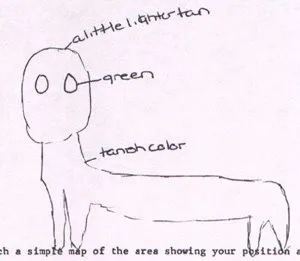
The following night, 22 April. Fifteen-year-old Abby Brabham was riding in a car with her boyfriend near Springdale Avenue. Once again, the setting was a quiet road at night, and once again, this sighting happened from a car. The creature Abby saw appeared low to the ground, and at first, she tried to compare it to something familiar. Some accounts say it struck her as monkey-like, which is a strange comparison in itself. Of course, there are no monkeys native to Dover, Massachusetts. The idea of a monkey moving along a dark roadside would already be bizarre. But the comparison seems to have been less about literal identification and more about posture or body shape. The creature was described as hairless or nearly hairless, with a thin body and a large head. It had no obvious tail, and like the earlier sightings, its eyes stood out. However, Abby described them differently from Bill. While Bill’s creature had orange, reflective eyes, Abby described them as greenish. That difference has often been used by sceptics to argue that the accounts may not describe the same thing, but differences in perceived eye colour can occur depending on the lighting, angle, distance and the witnesses’ positions. Headlight reflections are not always consistent, and fear does not make memory any clearer. What matters most is that Abby became the third young witness, within roughly 26 hours, to describe a strange, hairless, pale creature with an oversized head and unsettling proportions in Dover. By that point, the case had a pattern. The sightings occurred within a tight time frame. They happened in the same general area, and they involved a creature that did not look like a normal animal. And then, after Abby’s report, the pattern ended. The ending is one of the most important parts of the Dover Demon mystery. The creature did not become a recurring local menace. It did not keep appearing every April, and it did not trigger a wave of copycat sightings that stretched across the years. There are monster stories where the legend grows because more and more people claim to see the creature after hearing about it. But the Dover Demon is almost the opposite. It became famous because the window was so narrow. That narrowness gives the case a strange kind of power. It feels contained. As though something specific happened and then stopped. A legend with endless sightings can become messy. People add details. Stories contradict each other, and hoaxes multiply.
The original case gets buried under later claims, but the Dover Demon remains focused on a few key moments. Farm Street. Miller Hill Road. Springdale Avenue. 21 and 22 April 1977. Three teenagers. One strange creature. Or at least one strange idea that the witnesses seemed to be circling around. Of course, not everyone believed the witnesses had seen something unknown.
People often tried to explain what the teenagers had seen through a variety of theories, from misidentification and poor nighttime visibility to overactive imaginations. People see animals in poor lighting all the time and interpret them incorrectly. None of the animal explanations are impossible, but the description of the creature does not fit any of them perfectly either. One of the most persistent explanations is the possibility of a hoax. The witnesses were teenagers, and the sightings happened during school holiday week. That naturally made some adults suspicious. Teenagers can make things up, and a town with quiet roads and dark woods can be the perfect place for a scary story to spread. But the hoax theory also leaves questions. The witnesses were not all part of the same group. The sightings occurred in different places and under different circumstances. There was also no costume or prop ever produced or discovered. The Dover Demon does not behave like a creature from another local legend. There was no dramatic attack, no blood, no missing person or anything of the sort.
That does not necessarily mean that what the teenagers saw was real, but it does not automatically discredit their accounts either. Some people have also connected the Dover Demon’s imagery to something alien because of its large head, thin body and strange eyes. That comparison is easy to understand. The sightings also happened in the 1970s, a time when UFO stories and alien encounters were becoming deeply embedded in American pop culture. But the Dover Demon does not seem to fit here either because the case does not contain the usual elements of a UFO encounter.
In my opinion, it is more than likely that the teenagers misinterpreted some kind of animal. The fact that all three, in separate instances, described something similar does give that possibility more credence. They could have seen something strange, or perhaps the same animal. However, there is no real way to know exactly what happened that night. Whether the teenagers were in cahoots and made it up, whether they saw some kind of deformed animal, or whether they really saw what some people might consider a cryptid or an alien, we will probably never know.
So really, at this point, the legend becomes subjective. If something unknown really was seen that night, that may be why this story still has power nearly half a century later. It does not need a haunted house, a curse or any of the other supernatural or paranormal elements. Its description, honestly, is enough. These days, the roads where it was seen are quiet. The stone walls are empty. The trees barely move. But if you drive through Dover late at night, when the houses are dark and your headlights reach ahead of you into the bends of the road, it is not hard to understand why the story has survived. Because all it takes is one shape. Or perhaps no shape at all. One pale figure, crouched low beside the stones. One pair of eyes reflecting back at you. And one terrible second when your mind tries to call it an animal.
But something deeper knows that that answer may not be enough.