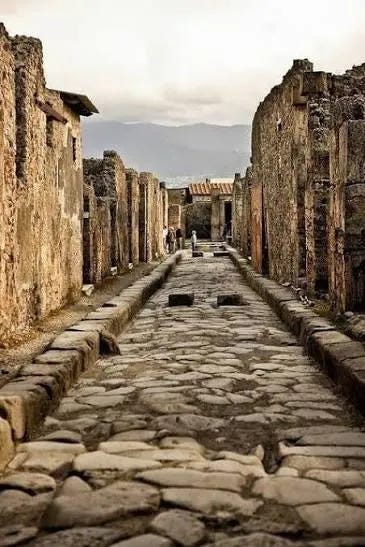

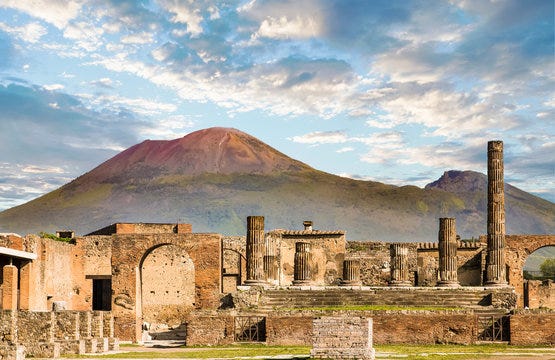
90% of the people in Pompeii survived. They packed their coin purses, loaded their carts and walked out of the city while volcanic rock rained from the sky. The ones who stayed behind (the ones whose plaster casts you see in museums) had 17 hours to leave. And they didn’t. The question that haunts archaeologists isn’t really why Vesuvius erupted. We know that part. The question is what those final hours actually felt like for the people who stayed. What did they see? What choices did they make? And when the killing cloud finally reached them, what happened to their bodies in those final seconds? Because we actually know, down to the molecular level. Recent forensic analysis, spectroscopic bone studies, DNA testing and elemental contamination patterns have given us an almost minute-by-minute reconstruction of how people died in Pompeii. And the answer is more complicated, more human and far more disturbing than the simple story most of us were told in school.
This is Tuesday, 24 August, 79 CE. The sun is high over the Bay of Naples. Pompeii is a thriving Roman city of roughly 11,000 people: merchants, politicians, soldiers, enslaved workers and children. Vesuvius looms to the north-west, but nobody thinks of it as dangerous. It hasn’t erupted in 1,200 years. The earthquakes of the past few days are normal for this region. Nothing to worry about. In about three hours, everything these people know is going to end. And over the next 32 hours, the volcano will release thermal energy equivalent to 100,000 times that of the Hiroshima and Nagasaki bombings combined.
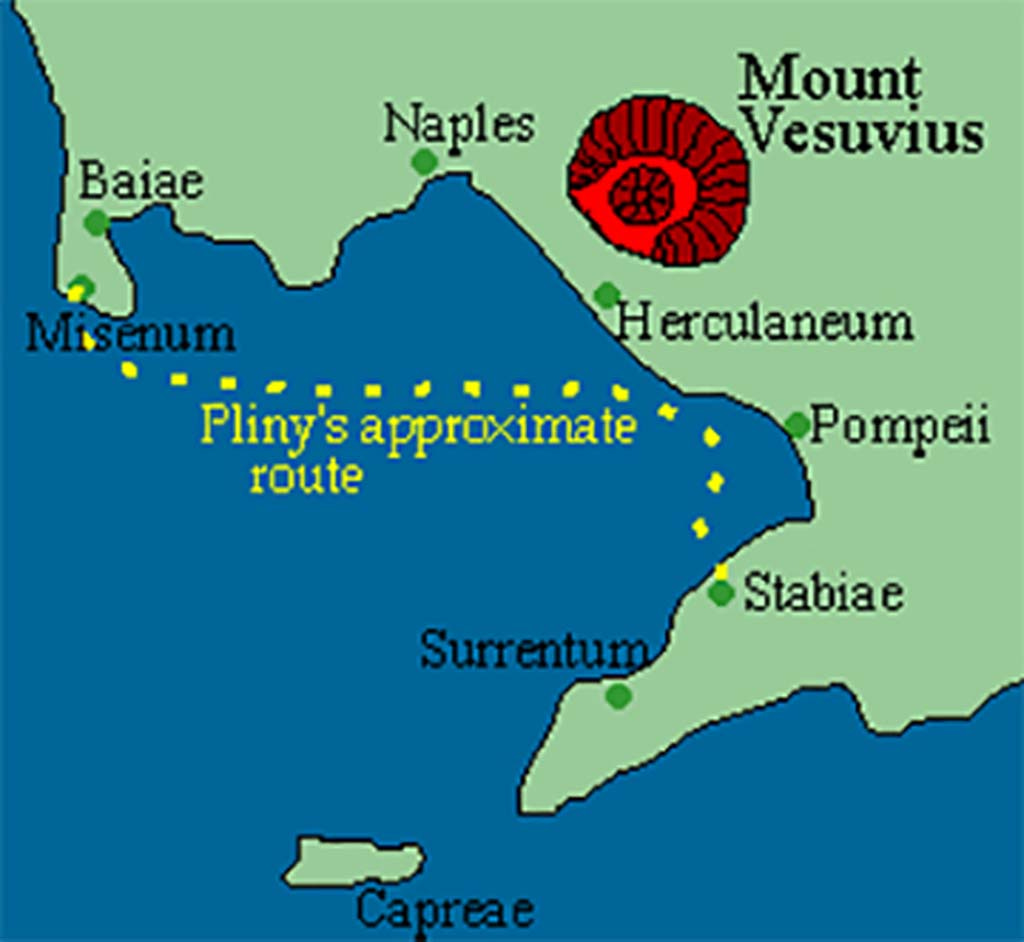
This is the timeline of what it was like to die in Pompeii. Tuesday, 24 August, 79 CE. Approximately 1:00 p.m. Thirty kilometres across the Bay of Naples, in the town of Misenum, a woman looks up from whatever she’s doing and notices something strange above Vesuvius. A cloud. Not a normal cloud, but something enormous and oddly shaped, rising from the mountain like a pillar before spreading out at the top. She points it out to her son and her brother-in-law. Her son is Pliny the Younger. He’s 17 years old. Her brother-in-law is Pliny the Elder, commander of the Roman Imperial Fleet and one of the most famous naturalists in the ancient world. He watches the cloud for a moment and then does something remarkable. He orders a boat to be prepared, not to flee, but to sail towards the volcano out of scientific curiosity. That decision will kill him within 24 hours. Back in Pompeii, six miles from the crater, the first sign of trouble drifts down from the sky at around 1:00 p.m.: ash. Fine grey volcanic ash settles on rooftops, market stalls and the shoulders of people going about their afternoon. It looks like dirty snow. Within an hour, the ash gives way to something worse. White pumice stones begin to fall. Small at first, then fist-sized, they descend at roughly 50 metres per second. Imagine standing outside and having gravel thrown at you continuously from the height of a skyscraper, with no pause, for hours. That is what the people of Pompeii are experiencing by 2 p.m. The pumice accumulates at a rate of 10 to 15 centimetres an hour.
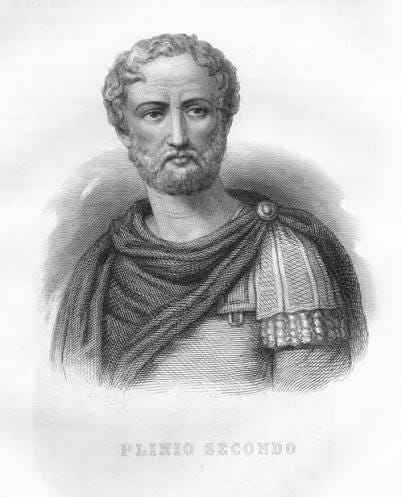
Within two hours, the streets are covered by half a foot of volcanic rock. Within four hours, it is two feet deep. And something else is happening that might be even more terrifying than the falling stones. The sun is gone. The eruption column has punched between 21 and 33 kilometres into the stratosphere, ejecting material at a rate of 1.5 million tonnes per second. The ash and volcanic debris have completely blocked out the sun. In the middle of the afternoon, Pompeii has been plunged into absolute darkness. Not twilight. Not overcast. Darkness so complete that Pliny the Younger, watching from across the bay, later wrote that it was blacker than any ordinary night. Imagine living in a world without electricity, without flashlights, without any reliable artificial light beyond oil lamps and torches. And at two o’clock in the afternoon, the sky goes completely black while rocks fall on your head. This is the moment when thousands of Pompeii’s residents make the most important decision of their lives. The majority choose correctly. They grab what they can carry and leave. Archaeological evidence confirms this in multiple ways.
When researchers excavated the stables in Pompeii, they found them empty. No horses, no mules, no carts. The residents had loaded their animals and driven out of the city. Strongboxes in homes were found with their lids open and their contents gone. People had taken their coins, their jewellery, their portable valuables. They understood that the city was in danger, and they acted. Later archaeological work would trace uniquely Pompeian family names. Names such as the Papidii and Umbrii were traced through inscriptions in neighbouring cities. At least 130 survivors have been formally identified in towns such as Naples and Puteoli, where they resettled, married into local populations and rebuilt their lives. Some later returned to the ruins of Pompeii, living in the upper storeys of buildings that remained above the ash layer and scavenging what they could. So, 90 to 95% of the population escaped. Out of a combined population of 15,000 to 20,000 across Pompeii and nearby Herculaneum, roughly 1,500 bodies have been recovered over three centuries of excavation. These are the people who stayed. And the reasons they stayed reveal something painful about the ancient world.
Professor Kimberly Bowes of the University of Pennsylvania studied the coins found on approximately 206 Pompeian skeletons, representing about 15% of all excavated remains. Her reasoning was straightforward. When people flee a catastrophe, they grab their portable wealth. The amount of money found on a body tells you something about how much that person had. The results are devastating. 95% of the victims carried between one and 50 certi. To put that in context, 50 certi could feed a free Roman citizen for one to two days. For an enslaved person, whose food costs were lower, it might stretch to two weeks. These were not wealthy homeowners who chose to ride out the storm. These were people with almost nothing. A small number of victims carried slightly more. But even those sums were trivial compared with the value of the houses in which they were found. What Bowes and other researchers believe is that many of the dead, particularly those found inside the largest and most opulent homes, were enslaved domestic workers. They were ordered to stay behind by masters who expected to return after the disaster and reclaim their property. In the Roman world, enslaved people were investments. You didn’t abandon your house without leaving someone behind to guard it. Contemporary estimates place the enslaved population of Herculaneum alone at 40 to 45% of the total. The skeletal evidence supports this theory. Many of the victims show signs of good nutrition, consistent with well-maintained household servants rather than disposable labour. These people were fed well precisely because they were valuable property. They were also property, ordered to stay. Others who remained behind included the elderly, the sick, the very young and anyone who couldn’t move quickly through streets choked with pumice in total darkness. Some were simply caught by surprise. Others believed the eruption would stop and chose to shelter inside, hoping to wait it out. For all of them, the waiting was about to end.
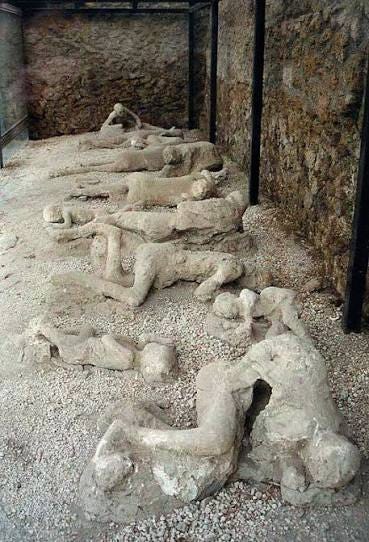
During the evening and through the night the pumice keeps falling. Hour after hour, by evening, nearly 280 centimetres of volcanic debris has accumulated - close to nine feet. The weight is extraordinary. Roofs that were never designed to bear this kind of load begin to crack, sag and collapse. Inside homes across Pompeii, the remaining residents hear the groaning of timber beams and the crack of tiles shattering overhead. Some die right there, right then, crushed beneath their own roofs. Two men, found at the Insula of the Chaste Lovers, a central city block, had sought shelter in what they thought was a strong house. Their skeletal remains were found crouched in a corner beneath a collapsed wall. Analysis confirmed that they survived the pumice fall. Their bones rested on top of the lower pumice layer, rather than being buried within it. They were alive and sheltering when something other than the eruption got them. An earthquake. A significant seismic event struck Pompeii in the gap between the pumice fall and the arrival of the pyroclastic surges. Periods of seismic activity had been shaking the city throughout the eruption. This intermediate quake was powerful enough to bring down the upper structure of the building where the two men were hiding. They died from traumatic crushing injuries. Not from heat. Not from suffocation. A wall collapsed on them while they waited for the volcano to stop. This is one of the things that makes the Pompeii disaster so layered. The eruption didn’t kill people in a single way. It presented a cascading sequence of hazards. Falling rock, structural collapse, earthquakes, toxic gases and, eventually, pyroclastic surges. Each one capable of killing in a different way. Each one arriving on its own timetable.
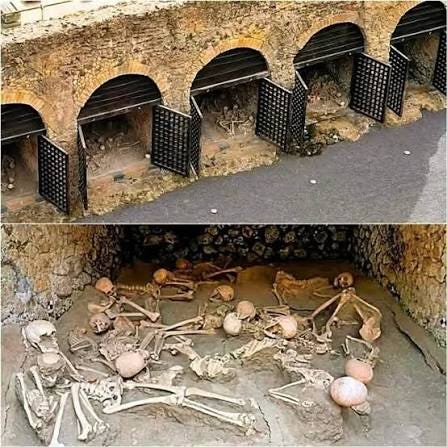
Meanwhile, in Herculaneum at 11:15 p.m., 24 August. While Pompeii endures its long night of falling pumice, the city of Herculaneum, closer to Vesuvius on the other side of the mountain, is about to experience something infinitely worse. Around 11:15 p.m., the volcanic column that has been shooting material into the stratosphere all day begins to collapse under its own weight. The material that has been going up is now coming down, not as pumice stones, but as a superheated avalanche of gas, ash and molten debris. This is a pyroclastic surge. It races down the slopes of Vesuvius at speeds exceeding 450 mph, riding on a cushion of compressed air that allows it to cross flat ground, flow over barriers and penetrate any structure in its path. In Herculaneum, approximately 300 to 340 people have gathered near the waterfront boathouses, hoping for evacuation by sea. The ships have not come. The harbour is too dangerous. The water is too rough. The volcanic debris is too thick. These people are trapped at the water’s edge with nowhere to go. When the first surge hits, the temperature inside those boathouses reaches between 400 and 900°F. To give you a reference point, a conventional kitchen oven maxes out at around 500°F. Some of these people are hit by temperatures nearly double that. What happens to a human body at 900°F is something forensic science can now describe with terrible precision. Death comes in a fraction of a second. The nervous system is overwhelmed before the brain can process what is happening. Spectroscopic analysis of the victims’ bones found extraordinary concentrations of iron oxides, the thermal decomposition products of haemoglobin. Their blood literally boiled. Many of the skulls recovered from Herculaneum display distinctive radiating fracture patterns. These aren’t impact fractures from falling debris. They’re pressure fractures caused by brain fluid turning to steam and expanding so violently that it cracks the skull from the inside out. The skeletal remains exhibit what forensic scientists call the pugilistic attitude. Their hands and feet contracted into rigid, fist-like positions. This is cadaveric spasm, an involuntary muscular contraction triggered by extreme heat shock. The victims’ muscles seized so violently and so quickly that their bodies locked into these contorted postures before they even fell to the ground.
Researchers studying these remains noted that the victims had no time to display any defensive reaction. No hands raised to their faces. No crouching. No turning away. The surge was so fast and so hot that there was no interval between life and death long enough for a single reflexive movement. There is a debate among anthropologists, and it’s worth mentioning because the truth is rarely as clean as we want it to be. Some researchers argue that the heat penetrated the boathouse walls more gradually than the instant vaporisation theory suggests. In this interpretation, the victims didn’t die in a flash. They asphyxiated over several minutes as the enclosed space filled with superheated air. Their soft tissues decomposed slowly rather than vaporising instantaneously. Either scenario is horrific. Whether it took a fraction of a second or several agonising minutes, the 300 people in those boathouses were dead before anyone in Pompeii even knew the surges had begun. And Pompeii’s turn was coming.
25 August, early morning. Approximately 6:30 to 6:45 a.m. Volcanological studies have identified 17 distinct pyroclastic currents during the eruption of Vesuvius, arriving roughly 80 minutes apart. The first few strike Herculaneum. The later ones push further out. Surges four and five, the largest and most devastating, reach Pompeii at around 6:30 a.m. on 25 August. By this point, anyone still alive in Pompeii has survived approximately 17 hours of continuous volcanic bombardment. Seventeen hours of pumice rain, collapsing buildings, earthquakes, total darkness, toxic fumes and the mounting terror of not knowing when it would end. And now, in the early morning hours, a new sound reaches them. A roaring, rushing wall of superheated gas and ash, moving faster than any chariot, any horse, any living thing. The surge that strikes Pompeii is different from the one that hit Herculaneum. An additional six miles has cooled it somewhat. Temperatures in Pompeii reached between 360 and 680°F, still far beyond any survivable threshold, but not the 900°F inferno that vaporised Herculaneum. This difference in temperature creates a fundamentally different experience of death. Most people in Pompeii do not die instantly. Elemental analysis published in 2023 in PLOS ONE confirmed what the body positions had long suggested. The plaster casts of Pompeii’s victims show people in relatively relaxed, prone postures, rather than the rigid, contorted, pugilistic positions seen in Herculaneum. This is the signature of asphyxiation, not thermal shock. These people suffocated over a period of seconds or minutes while still conscious. The sequence is brutal in its specificity. On the first breath, the victim inhales a superheated mixture of toxic gases. Carbon dioxide, hydrogen sulphide, sulphur dioxide, hydrogen chloride and hydrogen fluoride, laced with ultrafine volcanic ash and suspended at temperatures of 250°C or higher. This mixture does two things simultaneously. The heat sears the delicate tissues of the throat and lungs, while ash mixed with moisture in the airways begins to form a cement-like substance that coats the respiratory tract. The second breath thickens the mixture. The windpipe begins to constrict as the thermal and chemical damage compounds. The caustic gases, particularly sulphur dioxide and hydrogen chloride, react with moisture in the airways and form acids. The lining of the lungs is being chemically burned at the same time as it is being physically clogged with volcanic paste. The third breath often never comes. The ash-like cement has solidified in the airways, completely blocking the passage of air. Consciousness fades as oxygen levels in the blood drop and carbon dioxide levels rise. Within seconds to a few minutes, the victim loses consciousness and dies. Several of the plaster casts from Pompeii show victims with their hands raised to their faces, pressing cloth or their own palms over their mouths and noses. This is a defensive posture. They were trying to filter the air, trying to breathe through fabric, trying anything to block the lethal cloud pouring into their lungs. The casts preserve this final, futile gesture with heartbreaking clarity. Others show more relaxed positions, their bodies seeming almost peaceful. These are people who have lost consciousness. At high concentrations, the carbon dioxide in the surge acts as a narcotic. As oxygen disappeared and CO₂ levels climbed, some victims simply became drowsy, disoriented and then unconscious before death. They drifted off. By a slim margin, it is the least terrible way to die in Pompeii.
In 2025, archaeologists excavating a home along Via del Vesuvio uncovered one of the most detailed accounts of individual decision-making during the eruption. The house is called the House of Helle and Phrixus, named after a mythological fresco painted on its walls. The story it tells is extraordinary, not because it ends differently from the others, but because of how much we can reconstruct about what happened inside. Four individuals, likely a family and including a child, were in the house when the eruption began. Like most Roman homes in Pompeii, the house featured an atrium, an open-roofed courtyard designed to collect rainwater. A beautiful architectural feature in normal times. During a volcanic eruption, it became a funnel. Lapilli, the volcanic rock fragments, poured directly through the open roof into the centre of the house. The four occupants recognised the danger immediately. They retreated to a small bedroom and dragged a heavy wooden bed frame against the door, barricading themselves inside. Their strategy was logical. The interior room had a solid roof. The sealed door would keep out falling debris. If the eruption stopped, they could emerge unharmed. They waited there for hours. The pumice continued falling outside. The house creaked and groaned under the accumulating weight. The air grew thicker with volcanic dust seeping through every crack and joint in the masonry, but they held their position. The bed stayed against the door. Sometime in the early morning hours of 25 August, the conditions inside that sealed room became unbearable. The temperature was rising. Toxic gases, including carbon dioxide, were seeping through the gaps around the door and through the walls themselves, settling along the floor. The air was becoming unbreathable. And outside, through whatever cracks in the walls they could peer through, the pyroclastic surges were beginning. The family made their final decision. They pulled the bed away from the door. They abandoned the room that had sheltered them for seventeen hours. They tried to run. They made it as far as the triclinium, the dining room. Not the front door. Not the street. The dining room. All four of them were found there by archaeologists. Their remains were preserved in ash alongside a bronze protective amulet called a bulla, amphorae of expensive fish sauce known as garum, and the ghostly outline of the wooden bed frame itself, preserved in the volcanic deposit for nearly 2,000 years.
The discovery captures the full psychology of catastrophe in a single household. The initial denial: surely this will pass. The defensive action: barricade the door, seal the room. The hours of terrified waiting. And finally, the desperate calculation that staying was more dangerous than running, followed by the cruel discovery that it was already too late for either option. One of the most misunderstood aspects of the Pompeii disaster is the role of volcanic gases. The falling rock and the pyroclastic surges are the dramatic killers, the ones that make it into films and documentaries. The gases are invisible, and they were just as deadly. Carbon dioxide was the most insidious. Heavier than normal air, it settled into low-lying areas. It settled into low-lying areas, along streets, in cellars and on the ground floors of buildings. It displaced breathable oxygen silently and invisibly. A person walking through a Pompeian street during the eruption might have stepped into a pocket of concentrated CO₂ without seeing, smelling or sensing anything, until they suddenly became dizzy, confused and then unconscious. Sulphur dioxide produced a sharp, pungent odour that burned the eyes and throat on contact. Hydrogen sulphide, the rotten-egg gas, was both an irritant and an asphyxiant at the concentrations being released. Hydrogen chloride reacted with moisture to form hydrochloric acid, burning any tissue it contacted. These gases mixed with fine ash to create a cocktail that attacked the respiratory system from every possible angle: chemically burning tissue, mechanically blocking airways and displacing the oxygen needed to survive. Pliny the Elder, the fleet commander who had sailed towards the eruption out of curiosity, died at Stabiae, on the coast south of Pompeii.
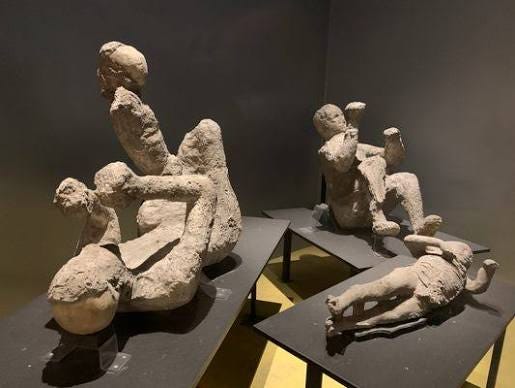
According to his nephew’s account, Pliny the Elder collapsed on a beach, reportedly overcome by toxic fumes and heat. His companions fled. His body was found days later, looking more like a sleeping man than a corpse. The gases had killed him gently, relatively speaking: a slow poisoning rather than a violent death. In the 1860s, an archaeologist named Giuseppe Fiorelli developed a technique that would make Pompeii one of the most recognisable archaeological sites on Earth. He realised that as the bodies of victims decomposed within the hardened ash, they left voids, hollow outlines of the people who had died there. By pouring liquid plaster into these voids, he could create three-dimensional casts of the victims in their final positions. He produced roughly 100 of these casts, and they became icons. The mother cradling her child. The family huddled together. The man shielding his face. These images have shaped how we think about Pompeii for more than 150 years. And a lot of what they seem to tell us turns out to be wrong.
DNA research published in 2024 has revealed that many of Fiorelli’s casts, and those made by later archaeologists, were, to use the academic term, creatively restored. Past researchers manipulated features and enhanced details to create narratives that aligned with their own assumptions about Roman family life. The famous cast long interpreted as a mother sheltering her child. DNA analysis showed that the two individuals were genetically unrelated. Another grouping that textbooks presented as a family turned out to include people with diverse genetic backgrounds who happened to die near one another. This doesn’t mean the casts are worthless. The body positions they capture are real. The general disposition of the victims, prone, defensive, curled, reflects their actual postures at the moment of death. What the casts don’t preserve is the human relationships we want to read into them. The emotional narratives, the loving mother, the protective father, were added later by archaeologists who saw what they wanted to see. What modern science reveals instead. Modern forensic techniques tell us different stories. X-ray fluorescence spectroscopy can read the elemental contamination patterns in bone fragments, distinguishing between people who died from heat exposure and those who died from suffocation. Protein analysis of bone collagen reveals whether remains experienced rapid, extreme heating or slower thermal degradation. Iron oxide concentrations in bones indicate whether blood underwent thermal decomposition, whether it boiled. These techniques have confirmed two distinct categories of death during the eruption. The instantaneous thermal deaths of Herculaneum and the slower deaths by asphyxiation in Pompeii, with a precision that Fiorelli could never have imagined.
The science is less emotionally satisfying than the plaster casts. There is no mother shielding her child. There are elemental signatures, fracture patterns and contamination profiles. What they reveal is less poetic and more truthful. Individual human beings, dying in specific, measurable ways. Their bones recording the mechanism of death at the molecular level. We have one detailed eyewitness account of the eruption, and it describes something that tends to get left out of visual reconstructions. Sound. Pliny the Younger was 17 years old, watching from Misenum, 30 km across the bay. Even at that distance, what he heard and saw was overwhelming enough that he wrote about it decades later in letters to the historian Tacitus. He described screams and wailing cutting through the darkness. The cries of women and infants. Crowds of people calling out desperately for parents, children and spouses, trying to identify loved ones by voice alone because the ash was so thick that visibility had dropped to almost nothing.
Think about that for a moment. Parents separated from their children in pitch darkness, with volcanic rock falling on their heads, unable to see more than a few feet. Screaming names into the black air and listening for a response that might never come.
Pliny also described the psychological texture of the catastrophe. People convinced the world was ending. People arguing about whether the gods had abandoned them. People making calculated decisions about which direction to run. Debating routes in the darkness. Trying to guess which roads were still passable beneath the pumice. The eruption wasn’t just a physical event. It was a psychological ordeal. Hours and hours of sustained terror, disorientation and impossible choices, with no information about what was happening and no way to know when it would stop.
The people inside Pompeii heard all of this. And worse, they heard roofs collapsing. They heard the rumble of earthquakes shaking the city’s foundations. They heard the continuous, relentless hammering of pumice on every surface. And then, in the early morning hours of 25 August, they heard a sound unlike anything that had come before. The roaring approach of the pyroclastic surge, moving towards them at 450 mph. That was the last sound any of them heard.
The archaeological record preserves traces of three distinct behavioural responses to the eruption, and each one tells us something about how humans process mortal danger. The first response was defensive engineering. In the House of the Painters at Work, archaeologists found the remains of individuals who had deliberately sealed themselves inside a narrow corridor, closing doors at both ends to create an enclosed chamber. Their logic was sound. Keep the toxic air out. Create a sealed space. Breathe whatever clean air remains inside until the eruption passes. The problem was that pyroclastic surges don’t behave like smoke. They are pressurised waves of superheated gas that penetrate every gap, every crack, every imperfection in any structure. The sealed corridor bought these people minutes, at most. The second response was companionship. In another residence, a young woman and an older man sealed themselves together in a small room. Their remains were found in close proximity. Not the pattern seen elsewhere of unrelated strangers dying near one another, but two people who chose to be together at the end. Whether they were family, friends or strangers who found comfort in each other’s presence. The archaeological evidence suggests that they died side by side, huddled together as the surge filled the room. The third response is the most haunting. Some of the plaster casts show bodies in utterly relaxed positions. Not defensive. Not sheltering. Not running. Just lying down. These are people who had reached the point of acceptance. Seventeen hours of terror had exhausted their capacity for action. The carbon dioxide building up in the lower air was making them drowsy. The situation was clearly hopeless. They lay down. They waited. And the ash buried them in the positions where they rested. Denial. Defence. Acceptance. The same pattern psychologists observe in modern disaster responses was playing out in Roman Italy 2,000 years ago. The human brain processes catastrophe in much the same way, whether you’re wearing a toga or a business suit.
25 August, 8:05 p.m. Thirty-two hours after the first ash drifted over Pompeii, the eruption of Mount Vesuvius finally stopped. The city was buried under roughly 20 feet of volcanic material. The landscape was unrecognisable. Where a city of 11,000 people had stood the previous morning, there was now a grey, silent plain. Approximately 1,500 people were dead beneath it. Some were killed in an instant by temperatures hot enough to boil blood inside the skull. Some suffocated over agonising minutes as volcanic cement filled their lungs. Some were crushed by collapsing buildings during the earthquakes that punctuated the eruption. Some were poisoned by invisible gases that pooled in the streets and low-lying rooms where they hid. Many of them (a disproportionate number, if Bowes’ research is correct) may have been enslaved people ordered to stay behind by owners who valued property over human life. People who had no legal right to make the choice that might have saved them. People carrying less than two days’ worth of food money when they died.
The plaster casts in Pompeii’s museums are imperfect records. We know that now.
The family groups were often invented by Victorian-era archaeologists. The emotional narratives were projected onto anonymous remains. The science is colder, more precise and less comforting than the stories we told ourselves for 150 years. And yet, what the science reveals might be more powerful than any plaster cast. It reveals that 2,000 years ago, when the world ended for 1,500 people in a Roman city, they responded much as any of us would. They calculated. They sheltered. They held each other. They covered their mouths. They ran when staying became more dangerous than running. They lay down when running became impossible.
They were, in every way that matters, exactly like us. The people of Pompeii had seventeen hours to decide their fate. And the man who decided to sail towards the volcano had even less time than that.